
Here are some words you will see as you learn about collecting stamps - what do they mean?
This is important !! You do NOT have to understand all the stuff below!! There are no tests!! If you find it confusing, then forget it, and go back to having fun with your stamps. But remember to come back here if you see a word you don't understand - OK?
Postage stamp
Postage stamps are stamps that you can buy at the Post Office
to put on letters and parcels that you mail to someone. Every country in the world has postage stamps.
When you stick stamps on an envelope or parcel, you prove that you have paid to have
them delivered to the address you put on the envelope or parcel. The bigger or heavier the parcel, the more you
have to pay and the more expensive are the stamps you buy.
Sheets of stamps
Stamps are usually printed in sheets containing many stamps.
Sometimes there are 100 or more stamps on a sheet. In the old days, all the stamps on a sheet were the same.
Now, there might be several different stamps on the same sheet.
Face
The face of a stamp is the side that shows the picture. Turn it over, and you see the gum or self-adhesive side
of the stamp.
Perforations, or perfs
These are the jagged edges around most stamps used until recently. They were invented a
long time ago to make it easier to remove a stamp from the "sheet" it is usually printed on. The stamp
printers did this by punching little holes in the sheets. Before the printers
put perforations around stamps, stamps had to be cut from the sheet with scissors. We often call
perforations "perfs". Today, many stamps are peeled off and do not have perfs :(
Perforation gauge
Sometimes, the Post Office made small holes in the sheets, and sometimes they made
large holes. Collectors treat stamps with different perforations as different stamps even
though they have the same picture.
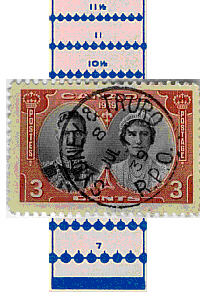 Suppose you knew that a stamp had been issued by the Post Office with two different sized perforations. How
can you tell if the perforations are different? With a perforation gauge, you can measure the perfs. A
perforation gauge has rows of dots spaced just right for each size perf. You place the stamp on it and find
which row lines up with the perfs on your stamp - then read the number.
Suppose you knew that a stamp had been issued by the Post Office with two different sized perforations. How
can you tell if the perforations are different? With a perforation gauge, you can measure the perfs. A
perforation gauge has rows of dots spaced just right for each size perf. You place the stamp on it and find
which row lines up with the perfs on your stamp - then read the number.
You will see that perf 10 has larger dots spaced farther apart from perf 14. The smaller the number, the larger the dots and the fewer the perfs on your stamp. You line up the perfs on your stamp with the marks between the holes (dots). In the example, the stamp seems to be perf 10 1/2.
Just to make this even more interesting, the perf size along the sides of the stamp were often different from the perf size along the top and bottom.
Imperforate
Before perforations were invented, stamps came in sheets with no holes in them. You
had to cut the stamps out with scissors. Stamps like that are called imperforate. Even after they began
perforating stamps, some issues were also made as imperforate, so you can collect examples of each.
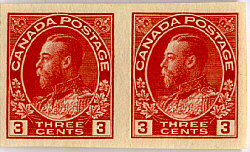
If you were in a hurry, you might not cut them perfectly, and a stamp might end up being snipped too close! Those stamps are less valuable than the ones that still show lots of space around the outside of the stamp. When you have a chance, look at the "Condition" section of this website.
The best way to be sure that you own an imperforate copy of a stamp is to have a pair of them together like in the illustration above.
Cover
A cover is an envelope that was used to send mail, such as a letter. Most covers that
people collect still have the stamps on them, but not all. Before stamps were invented, people sent
letters in what are called "stamp-less" covers. How did the Post Office know that you paid the
money they needed to operate the Post Office? Usually, someone at the Post Office just wrote down the
amount that you paid. For example, before there were stamps in Canada, and when Canadians used British
money, it might have cost 3 pence to send a letter somewhere. You paid the 3 pence and the person
at the post office wrote a big "3" in the top right corner.
